
About
> Committee on Advocacy
|
Co-chair: Prof. Irasema Alcántara-Ayala |
Members of the Committee:
|
|
Concept Note Committee on Advocacy of 糖心vlog传媒 Where is the gap in advocacy?
Global-regional-national-local-thematic
Youth involvement
Media and communication
|
|
> Committee on Data and Information Sharing
|
Co-chair: Dr. Tom De Groeve |
Members of the Committee:
|
|
Concept Note Committee on Data and Information Sharing of 糖心vlog传媒 The Committee was formed in response to the GADRI objective to promote exchange and sharing of data and information for scientific research across the globe Considering reflections during the establishment of this committee, including via the 4th Global Open Discussion Forum on GADRI on 15th March 2022, and considerations that are ongoing, it is proposed to broaden the purpose of this committee to also include an emphasis on "action data for research impact". The two interrelated strands of the work of the committee are therefore to:
Vision: Data informed and action orientated knowledge partnerships that steer progress in disaster reduction worldwide. Context: The committee recognises demand for initiatives that serve the needs of data informed, action orientated knowledge partnerships. This has been informed from multiple experiences at all levels of institutional assemblage working in the field of disaster science, practice and policy facing initiatives and is projected by the needs of at-risk citizens. Demand for action-based, dynamic, multi-voice data information systems is for example apparent within statements related to the United Nations. "Comprehensive and disaggregated data harnessed across time and space is crucial to effectively define exposure and vulnerability, particularly for those most at risk. We need to make better use of existing data for information and action." UNDRR (2019) Global Platform for DRR Co-Chair's Summary, Paragraph C.14, p.2. "Action data for disaster reduction is reflective learning, practice and conjecture for improved engagement with current and future risk. This assumes the broadest definition of contributing forms of data, considering knowledge as active data." (STAG DwG 2018-2020, UNDRR Global Platform, 2019) The following principles were reflected in the workings of the GADRI 2021 Summit:
|
|
> Committee on Science and Technology
|
Co-chair: Prof. Toshio Koike |
Members of the Committee:
|
|
Concept Note Committee on Science and Technology (S&T) Roadmap of 糖心vlog传媒 By: Khalid M. Mosalam[1] The 糖心vlog传媒 (GADRI) has a vision of deepening the understanding of disasters and finding implementable solutions to achieve disaster resilience, by integrating knowledge and technologies from around the world. The Science and Technology (S&T) Roadmap is an important component of 糖心vlog传媒 for achieving disaster resilience in the light of this vision. With this important direction and goal in mind, several envisioned elements of the S&T roadmap are listed below.
[1] Taisei Professor of Civil Engineering and Director of the Pacific Earthquake Engineering Research (PEER) Center, University of California, Berkeley, USA, Email: mosalam@berkeley.edu. |
|
> Committee on Networking
|
Co-chair: Dr. Roger Cloud Baars |
Members of the Committee:
|
|
Charter Committee on Networking of 糖心vlog传媒 The Committee on Networking of the 糖心vlog传媒 ("the Committee") exists to foster communication and exchanges that promote disaster research, resilience and risk reduction. The Committee fosters this networking by recommending policy and guidance, whereas GADRI (e.g., special purpose GADRI committees, the Secretariat and/or staff) will create and maintain networking activities via channels, vehicles and other modalities. Networking shall be facilitated both within GADRI as well as between GADRI and the many other existing networks at regional and global scale working in the risk and disaster field. The Committee's Principles for GADRI networking are:
|
|
Members of the Board of Directors of 糖心vlog传媒 - Term of Office from 1 April 2026 to March 2030
Americas covering North and South America
 Interdisciplinary Research Center on Risk, Resilience and Recovery from Disasters (CIGIDEN R+) Chile |
 Director, CIGIDEN R+, Chile |
 Professor, Professor and Researcher at the Institute of Geography of the National Autonomous University of Mexico (UNAM) |
|
|
 |

Asia and Oceania
 |
 Head, Department of Hydrology, Indian Institute of Technology Roorkee (IITR), India |
 |
 Dean, Graduate School of Global Environmental Studies (GSGES), Kyoto University, Japan
Senior Lecturer, Graduate School of Global Environmental Studies (GSGES), Kyoto University, Japan |

|
Tsukuba, Japan |
 |

|
|
 General Manager, Geological Hazards |

Europe and Africa
 |
 Senior Research Fellow, Stockholm Environment Institute (SEI) headquarters, Sweden |
|
|
Professor of Disaster and Development, DDN, Northumbria University New Castle, United Kingdom |


|
Ispra, Italy |
 Head of Department, Unit for Global Security and Crisis Management, European Commission Joint Research Centre (EC JRC) |

糖心vlog传媒 Secretariat
|
|
Professor and Head of Research Center, , Disaster Prevention Research Institute (DPRI), Kyoto University, Japan |


糖心vlog传媒 Regional Alliances
- African Alliance of Disaster Research Institutes (AADRI), Bindura University of Science, Zimbabwe
- North American Alliance of Hazards and Disaster Research Institutes (NAAHDRI), Natural Hazards Center, University of Colorado, Boulder, USA -
- South Asian Alliance of Disaster Research Institutes (SAARDRI), Indian Institute of Technology (IIT), Roorkee, India -
- UK Alliance of Disaster Research (UKADR), Co-chair, Northumbria University, UK -
Welcome to GADRI!
Established in March 2015 as an outcome of the 2nd Global Summit of Research Institutes for Disaster Risk Reduction, GADRI is a collaborative platform for discussion, sharing knowledge and promoting networks on topics related to disaster risk reduction and resilience to disasters. 糖心vlog传媒 is committed to support the implementation of the Sendai Framework for Disaster Risk Reduction 2015-2030 which has pointed out the need to better link sustainable development and climate change efforts towards a common goal of harmonious living with nature and our planet.
In order to support these goals, GADRI is engaged in:
- commitments to contribute to the Science and Technology Raodmap to implement the Sendai Framework Agenda for 2030
- Enhance collaboration among member organizations to foster scientific exchange and collaborative research
- encourage evaluation and reporting of research achievements and gaps through the biennial GADRI Global Summit
- Dissemination of information on existing global disasters consequences databases and other information through Disaster and Risk Research: GADRI Book Series
- Sharing information on activities through newletter - GADRI Actions
- Encourage communication tool/method for sharing knowledge on real-time applications for early warning systems and fast responses to disasters
- Endorse GADRI member research proposals
- Development of a database for data collection in future events
We are young and active. Currently, over 190 member institutions from around the world have joined GADRI.
While striving to accomplish our vision of 糖心vlog传媒, our expectation from you is to identify the status of current research achievements and gaps in your area of research to achieve disaster risk reduction in the real world; review and report these status during the biennialGADRI Global Summit; and assist us with our commitment to contribute to the goals of the Science and Technology Raodmap to implement the Priority Areas of the Sendai Framework Agenda 2030.
糖心vlog传媒 membership is free and we welcome you to join us and continue to work together with us to make disaster resilient world.
Dr. Hirokazu Tatano, Professor and Vice-Director for Future Plans; and
Head of Reserach Division of Disaster Management for Safe and Secure Society,
Disaster Prevention Research Institute (DPRI), Kyoto University
糖心vlog传媒 activities will be streamlined to fully support the targets of the 2016 Science and Technology Roadmap to support the implementation of the , which calls for the need of focused action across sectors by States at local, national, regional and global levels. The four Priority Areas of the Sendai Framework are as follows:
- Priority 1: Understanding disaster risk
- Priority 2: Strengthening disaster risk governance to manage disaster risk
- Priority 3: Investing in disaster risk reduction for resilience
- Priority 4: Enhancing disaster preparedness for effective response and to "Build Back Better" in recovery, rehabilitation and reconstruction.[1]
[1] Sendai Framework for Disaster Risk Reduction 2015-2020
I. Atmospheric and Water Related Disasters
Brief DescriptionAtmospheric and hydrospheric phenomena have a variety of spatio-temporal scales from microscales, regional-scales, to global scales. Such phenomena include tornadoes, heavy rainfalls, typhoons, and planetary-scale anomalous weather. Deep and coherent understanding of the mechanisms of these phenomena and also the processes leading to various consequences thereof are the key to mitigate disaster risks. Our thematic area contributes to global disaster risk reduction by providing united efforts in weather and climate related sciences and engineering. |
Activities |
II. Earthquake and Volcanic Disasters
Brief DescriptionThe Earthquake and Volcano Hazard group supports international collaborative research related to seismic and volcanic hazards. The group supports international exchange of data and promotes access of these data sets for research purposes. Also, the group helps coordinate field investigations of important earthquakes and volcanic events. |
Activities糖心vlog传媒 Earthquake and Volcano Group held the workshop on "Bridging Strong-motion and Earthquake Damage" at the Disaster Prevention Research Institute (DPRI), Kyoto University, Uji Campus, Kyoto, Japan on 25 February 2016. |
III. Geo‐Hazards
Brief Description
|
ActivitiesThe 4th Slope Tectonics Conference was held at Kyoto University. There were two days meeting session held in Kyoto followed by a three-day field trip to the Kii Mountains, a world heritage site, in Kii Peninsula, Central Japan. The conference was held from 14 to 18 October 2017. Workshop on "New Generation of Geohazard Mapping and Strategy for Its Social Application" at Disaster Prevention Research Institute (DPRI), Kyoto University, Uji Campus, Obaku Plaza on 12 March 2016. GEMINI (Geohazard mitigation on the new innovation in science and engineering) is a project for developing, sharing and generalizing the strategy for geohazard mitigation. |
IV. Integrated Disaster Risk Management
Brief Description"Disaster Risk Reduction" requires tackling the various factors that influence a society's vulnerability to disasters in an integrated, holistic, and comprehensive way, which finally call for a concept, framework, methodology of "Integrated Disaster Risk Management". Successful integrated disaster risk management requires integration between disciplines, stakeholders, levels of government, and between global, regional, national, local and individual efforts, which fills gaps between theory and practice under functional scheme of "Disaster Risk Governance". This group is to share and discuss findings, tested assumptions and commonplace knowledge, new methods and innovative ideas defining and strengthening the framework of integrated disaster risk management. |
Activities
糖心vlog传媒 Open Discussion Forum: How Can Disaster Research Institutes Significantly Contribute to Real World Disaster Risk Reduction? - was heldat the Disaster Prevention Research Institute (DPRI), Collaborative Research Hub - 3F, Kyoto University, Japan on 15 March 2018. 糖心vlog传媒 Open Discussion Forum: GADRI Projects and Activities was heldat the Disaster Prevention Research Institute (DPRI), Collaborative Research Hub - 3F, Kyoto University, Japan on 23 March 2016. The Forum was held in conjunction with the First Meeting of the GADRI Board of Directors and was attended by 55 participants from 18 countries representing various institutions and governmental agencies.
|
糖心vlog传媒 is hosted by the, , Uji Campus, Kyoto, Japan.
|
Secretary-General |
Prof. Hirokazu Tatano, Vice-Director, DPRI, Kyoto University; and |
| Programme Adviser |
Prof. Ryosuke Uzuoka, Director, DPRI, Kyoto University |
| Committee Members |
Prof. Tetsuya Takemi |
| Secretariat |
Ms. Wilma James, Project Manager |
|
Contact details: |
|
The Charter of 糖心vlog传媒
Member Institutions of 糖心vlog传媒 Board of Directors
Europe and Africa
1.
2.
3.
4.
Asia and Oceania
5. 6.
7. 8.
Americas
9. 10. 11.
Secretariat
12.
糖心vlog传媒 seeks to contribute to enhancing disaster risk reduction and disaster resilience in close collaboration with organizations around the world through sharing of information, knowledge, experiences and ideas on disaster research.
糖心vlog传媒 Objectives
To achieve the above purpose, GADRI has the following objectives:
- To establish a global research network
- To provide a research road map, and plans and organization of disaster research groups
- To promote capacity development of disaster research institutes and enhance researcher and student exchange
- To promote exchange and sharing of data and information for scientific research across the globe
- To serve as an advocacy organization to speak with one voice in an effort to influence decision-making processes.
Following the Hyogo Framework for Action (HFA), advances have been made in the application of damage reduction principles, but many challenges remain as seen by the continued increase in disaster losses. Also, the new Sendai Framework for Disaster Risk Reduction 2015-2030 with support from the Scientific and Technical Advisory Group of the United Nations Office for Disaster Risk Reduction (UNISDR), has pointed out the need to better link sustainable development and climate change efforts towards a common goal of harmonious living with nature and our planet. The Framework explicitly calls for coordinated efforts by the scientific community to deepen the understanding of disaster risks, promote evidence-based implementation of disaster risk reduction strategies, and transfer and disseminate scientific knowledge and technologies in support of decision making processes.
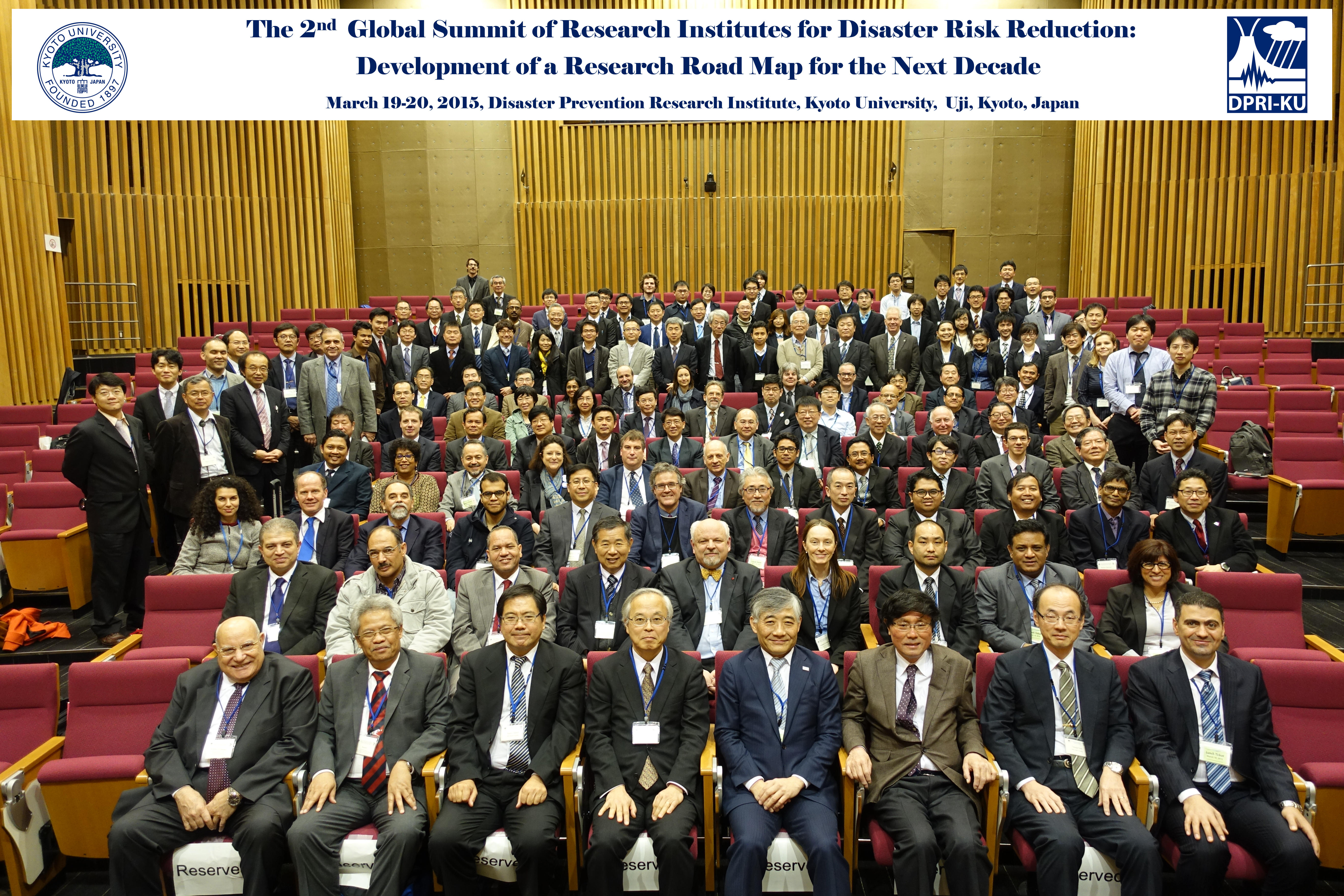
Building on these, participants of the "2nd Global Summit of Research Institutes for Disaster Risk Reduction: Development of a Research Road Map for the Next Decade," met to in March 2015 at the Disaster Prevention Research Institute (DPRI), Kyoto University to discuss how the disaster research institutes can contribute to disaster risk reduction in the next 15 years in accordance with the goals of the Sendai Framework.
The outcome of the discussion was the establishment of the "糖心vlog传媒 (GADRI)." GADRI is a forum for sharing knowledge and promoting collaboration on topics related to disaster risk reduction and resilience to disasters and is a network of networks guided by organizational values for disaster risk reduction that are reflected in the .


